Japanese Minimalism Philosophy
Share
Japanese minimalism is more than a look. It is a way of choosing, arranging and caring for fewer, better things so they serve with clarity and calm. Rather than stripping life bare, it removes noise so what matters can breathe. Rooted in Zen-influenced aesthetics, principles like ma, wabi-sabi, kanso and shibui turn space, simplicity and subtle detail into quiet power. The result is design and daily living that feel lighter, last longer and help you see differently. Learn how this shapes our brand in our brand story.
What sets Japanese minimalism apart
Western minimalism often centers on sleek surfaces and visual reduction. Japanese minimalism goes deeper - it treats emptiness, time and material as active elements. Space has a job, patina is welcome, and function leads form. Influenced by Zen and Shinto, it favors restraint, natural textures and ritual care. That is why styles like Japandi - a blend of Japanese minimalism and Scandinavian warmth - feel calm yet human. The aim is not less for its own sake, but meaning with less. For deeper essays on minimalism and timeless design, visit our journal.
Core principles of Japanese minimalism
Ma - purposeful space
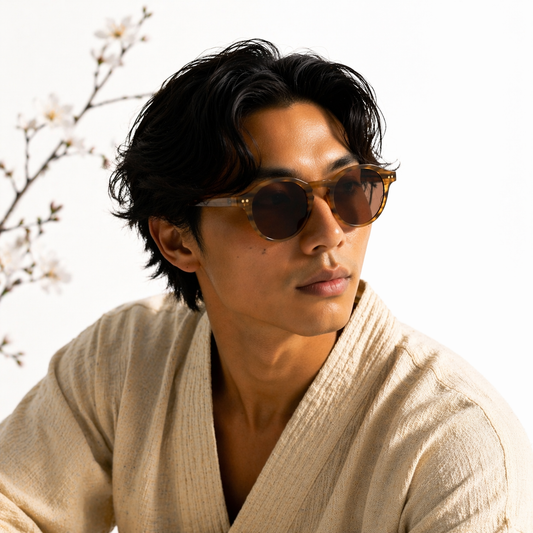
Ma is the intentional gap between things - the pause that gives shape to sound, the margin that lets an object breathe. In rooms it appears as uncluttered floor and clear sight lines. In products it shows up as clean edges, generous negative space and layouts that are easy to scan. Practice ma by leaving shelves partly empty, allowing white space in your schedule and keeping your phone’s home screen sparse. In style, choose accessories that feel light on the face and leave room around the silhouette. For a concrete example, see Minimalist sunglasses with a timeless presence.
Wabi-sabi - beauty in imperfection
Wabi-sabi finds quiet beauty in the imperfect and the transient. Think of kintsugi - a cracked bowl repaired with visible seams - where history becomes part of the design. Instead of chasing flawless newness, choose materials that age well and show care over time. Favor wood, linen and brushed metal, and repair before replacing. A small scuff does not ruin the story - it can be the story. This mindset reduces waste, deepens attachment and makes simple possessions feel alive.
Kanso - simplicity with purpose
Kanso is clarity through elimination. It cuts the ornamental and keeps only what adds real use or delight. Start by defining the job to be done, then remove what distracts. One versatile item that works daily often beats three specialized ones that rarely leave the shelf. In wardrobes, aim for clean lines, neutral tones and minimal branding. In digital life, uninstall unused apps and turn off nonessential alerts. Kanso is not austere - it is focused, friendly and easy to live with.
Shibui - understated elegance
Shibui describes quiet refinement that reveals depth slowly. Colors are muted, details subtle, proportions balanced. Nothing shouts, yet nothing is dull. A shibui object holds interest through texture, weight, and small decisions done right - the curve of a temple arm, the feel of a hinge, the way light hits a matte finish. To cultivate shibui, look for restraint, harmony and comfort in use. You will notice you tire of such pieces far less, which is the essence of sustainable style.
Hinshitsu - fewer, better things
Hinshitsu points to quality you can trust. It favors a small set of well-made essentials over many compromises. Practically, that means choosing durable materials, timeless shapes and products with parts you can service. Keep a shortlist, research before buying, and ask if an item will still make sense a year from now. Quality reduces decision fatigue and waste while raising everyday satisfaction.
Put it into practice
Quick checklist
- Edit first - remove what you no longer use before buying anything new.
- Create negative space - leave shelves and walls partially empty on purpose.
- Choose natural texture - favor materials that age well and can be repaired.
- Limit palettes - stick to a few colors to simplify matching and reduce clutter.
- Adopt one-in, one-out - maintain balance with each new addition.
- Ask three questions - does it serve, will it last, will I care for it.
If minimalism resonates with how you see the world, pick timeless accessories that prioritize fit, comfort and clarity over ornament. That is how you carry calm into every day. For more related reading, explore our news & articles.
FAQ
What is the Japanese minimalism principle?
It is a philosophy that seeks meaning with less - using space, simplicity and natural materials to highlight what matters. Through ideas like ma, wabi-sabi, kanso and shibui, it removes noise, embraces patina and favors durable essentials. The result is environments and objects that feel calm, useful and quietly beautiful.
What are the 7 principles of wabi-sabi?
They are often summarized as:
- Kanso - simplicity
- Fukinsei - asymmetry
- Shizen - naturalness
- Yugen - subtle depth
- Datsuzoku - freedom from habit
- Shibui - understated elegance
- Seijaku - tranquility